Is my wall suitable for cavity wall insulation?
Most homes built from the 1920s onwards have cavity walls, but having a cavity is not the same as being suitable. The Energy Saving Trust's rule of thumb is a cavity of at least 50mm, clear of rubble, behind masonry in good condition, on a wall that is not exposed to severe driving rain or flood risk.
That is what our survey checks: wall construction and thickness, cavity width and cleanliness (with a borescope where needed), the state of bricks, pointing, gutters and downpipes, any existing damp, and the exposure of each elevation. If a wall should not be filled, you will be told so in writing, with the reason.
What happens on the day?
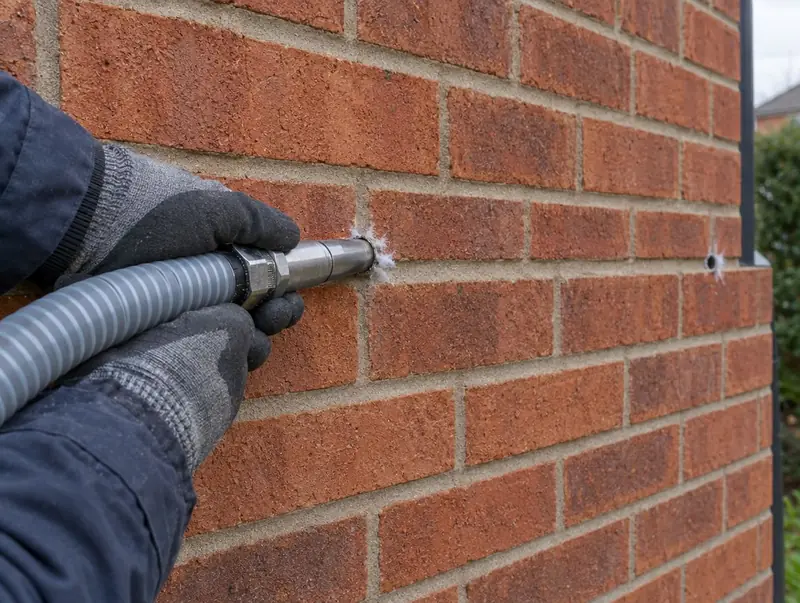
Holes of around 22mm are drilled in the mortar joints in a set pattern, roughly a metre apart. The insulation is blown in from the bottom up until each section is full, then every hole is filled with colour-matched mortar. Air bricks and flues are protected, and a cavity barrier is fitted where your wall joins a neighbour's.
For an average house with easy access to the walls, the filling itself takes a few hours. Scaffolding or a tower is only needed for three-storey walls or awkward access, and that is priced up front.
Which material goes in?
Usually blown mineral wool or bonded polystyrene beads, both third-party certified for cavity fill. The survey picks the system that suits your cavity width, wall condition and exposure zone, not whichever is cheapest on the day. Old-style urea-formaldehyde foam is not used.
What is included
- Suitability survey with photos and a written result
- Borescope check where the cavity is in doubt
- Certified mineral wool or bonded bead system
- Drilling, filling and colour-matched making good
- Cavity barriers at party walls
- Building regulations route for your nation, confirmed in writing
- Guarantee and installer named on your quote
Cavity wall insulation prices
| Cavity wall insulation guide prices | Guide price |
|---|---|
| Detached house | £2,295–£3,795 |
| Semi-detached house | £1,495–£2,495 |
| End-terrace house | £1,295–£2,195 |
| Detached bungalow | £1,295–£2,195 |
| Semi-detached bungalow | £895–£1,595 |
| Mid-terrace house | £795–£1,395 |
No VAT is charged on installing insulation in homes until 31 March 2027 (then 5%). Guide ranges only: the fixed price is confirmed in writing before any work starts, and anything that could not be seen at survey is agreed with you first.
Rules and funding by nation
The building regulations route and the funding schemes differ between England, Wales, Scotland and Northern Ireland. The local pages for your area explain the rules where you are; in short:
- England: Filling a cavity is notifiable building work and needs a building notice or competent-person self-certification.
- Wales: Filling a cavity is notifiable work under the Building Regulations as they apply in Wales, usually self-certified through a competent person scheme.
- Scotland: No building warrant is needed for insulation within a wall, but the work must meet the building standards.
- Northern Ireland: Inserting cavity wall insulation needs a building control application to the council before work starts.
Sources: Energy Saving Trust: cavity wall insulation; Planning Portal: cavity wall insulation and building regulations; Welsh Government: building work competent person schemes; HMRC: VAT on energy-saving materials (Notice 708/6).