Cavity wall insulation across Glasgow
We cover Glasgow and its surrounding districts.
Before any material is chosen, exposure is checked. Parts of Glasgow face some of the heaviest wind-driven rain in the UK, especially exposed coastal and upland sites. Here the survey is stricter: some walls suit only certain certified systems, and some should not be filled at all.
For semi-detached and terraced homes in Glasgow, cavity barriers are fitted where your wall meets your neighbour's so the fill stays on your side. Most Glasgow houses built from the 1920s onwards have cavity walls, but the survey still checks each one: cavity width, debris, the condition of the brickwork and how exposed each wall is.
Building standards in Scotland
In Scotland, work associated with thermal insulating material within a wall is listed in schedule 3 of the Building (Scotland) Regulations as work that does not need a building warrant. It must still meet the building standards, so the survey still checks that the wall and the chosen material are suitable, including exposure to wind-driven rain.
Funding in Scotland
- Home Energy Scotland is the starting point for the Home Energy Scotland Grant and Loan and for Warmer Homes Scotland, which can include cavity wall insulation.
- Many councils also run area-based schemes for insulation in particular streets or estates.
- ECO4 runs until 31 December 2026 across Great Britain, including Scotland.
Sources: Scottish Government: building work not requiring a warrant (schedule 3); Home Energy Scotland; mygov.scot: grants and loans for energy saving improvements; GOV.UK: extending the ECO4 end date, government response.
Is my wall suitable for cavity wall insulation?
Most homes built from the 1920s onwards have cavity walls, but having a cavity is not the same as being suitable. The Energy Saving Trust's rule of thumb is a cavity of at least 50mm, clear of rubble, behind masonry in good condition, on a wall that is not exposed to severe driving rain or flood risk.
That is what our survey checks: wall construction and thickness, cavity width and cleanliness (with a borescope where needed), the state of bricks, pointing, gutters and downpipes, any existing damp, and the exposure of each elevation. If a wall should not be filled, you will be told so in writing, with the reason.
What is included
- Suitability survey with photos and a written result
- Borescope check where the cavity is in doubt
- Certified mineral wool or bonded bead system
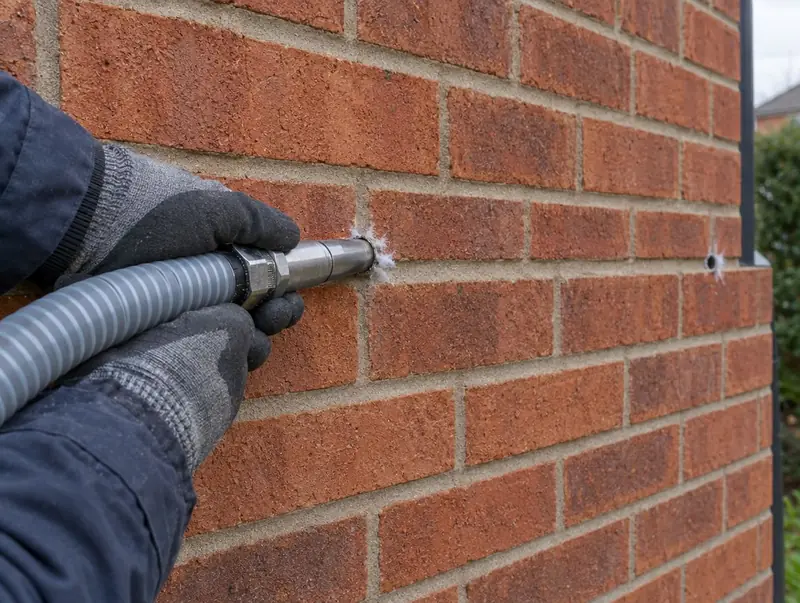
- Drilling, filling and colour-matched making good
- Cavity barriers at party walls
- Building regulations route for your nation, confirmed in writing
- Guarantee and installer named on your quote
Cavity wall insulation prices in Glasgow
| Cavity wall insulation guide prices | Guide price |
|---|---|
| Detached house | £2,295–£3,795 |
| Semi-detached house | £1,495–£2,495 |
| End-terrace house | £1,295–£2,195 |
| Detached bungalow | £1,295–£2,195 |
| Semi-detached bungalow | £895–£1,595 |
| Mid-terrace house | £795–£1,395 |
No VAT is charged on installing insulation in homes until 31 March 2027 (then 5%). Guide ranges only: the fixed price is confirmed in writing before any work starts, and anything that could not be seen at survey is agreed with you first.
How it works in Glasgow:
Get in touch
Online, by phone or WhatsApp, whichever suits you.
Survey visit
The surveyor checks each wall and looks into the cavity where needed.
Your result in writing
What we found, what it means, and a fixed price if work is needed.
Booked work
Carried out by the installer named on your quote, with their scheme registrations.