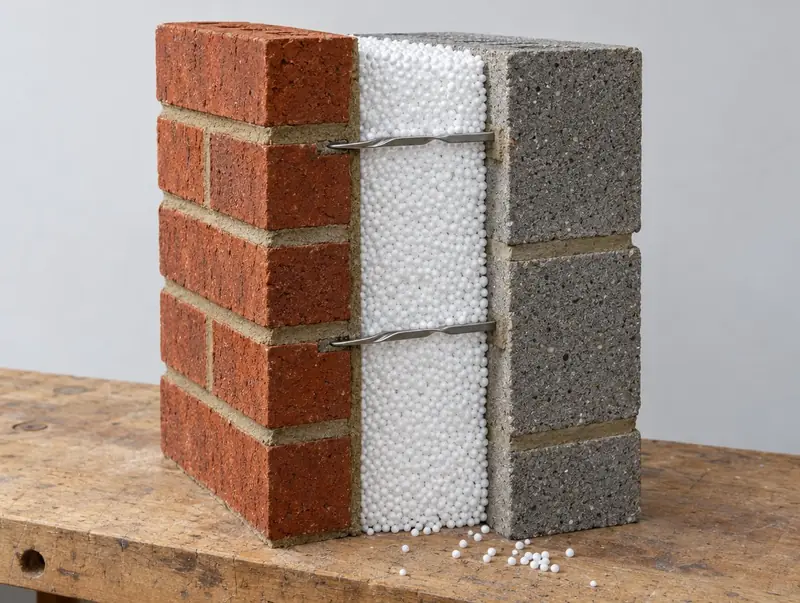
Where bonded beads make sense
Beads behave a little like a liquid as they go in, so they fill narrow and irregular cavities more evenly than fibre. The binder stops them pouring out if a brick is removed later. Some certified bead systems are approved for higher driving-rain exposure than fibre systems, which is why they are common on western and coastal elevations.
What to know before you choose beads
Polystyrene is combustible, so beads are not the right choice for every building; height, use and nearby openings matter, and the system certificate sets the limits. PVC-sheathed cables in the cavity should be sleeved or kept out of contact with the beads where the certificate requires it. We check both at survey.
What is included
- Certified bonded bead system
- Binder applied at the nozzle
- Making good to the mortar colour
- Cable and opening checks at survey
- Regulations route and guarantee named on the quote
Bonded polystyrene bead insulation prices
| Bonded polystyrene bead insulation guide prices | Guide price |
|---|---|
| Detached house | £2,295–£3,795 |
| Semi-detached house | £1,495–£2,495 |
| End-terrace house | £1,295–£2,195 |
| Detached bungalow | £1,295–£2,195 |
| Semi-detached bungalow | £895–£1,595 |
| Mid-terrace house | £795–£1,395 |
No VAT is charged on installing insulation in homes until 31 March 2027 (then 5%). Guide ranges only: the fixed price is confirmed in writing before any work starts, and anything that could not be seen at survey is agreed with you first.
Rules and funding by nation
The building regulations route and the funding schemes differ between England, Wales, Scotland and Northern Ireland. The local pages for your area explain the rules where you are; in short:
- England: Filling a cavity is notifiable building work and needs a building notice or competent-person self-certification.
- Wales: Filling a cavity is notifiable work under the Building Regulations as they apply in Wales, usually self-certified through a competent person scheme.
- Scotland: No building warrant is needed for insulation within a wall, but the work must meet the building standards.
- Northern Ireland: Inserting cavity wall insulation needs a building control application to the council before work starts.
Sources: Energy Saving Trust: cavity wall insulation; Planning Portal: cavity wall insulation and building regulations; Welsh Government: building work competent person schemes; HMRC: VAT on energy-saving materials (Notice 708/6).