Cavity wall insulation across Nottinghamshire
We cover 10 towns in Nottinghamshire, including Nottingham, Mansfield, Worksop, Newark on Trent, Arnold and more.
Local weather affects which walls can be filled. Much of Nottinghamshire sits in the more sheltered driving-rain zones of the UK, which widens the choice of fill. Exposed elevations, coastal sites and high ground still get checked wall by wall.
Most Nottinghamshire houses built from the 1920s onwards have cavity walls, but the survey still checks each one: cavity width, debris, the condition of the brickwork and how exposed each wall is. Nottinghamshire properties with rendered or painted walls get a closer look at the outer finish, because cracked render can let rain behind it.
Building Regulations in England
Filling an existing cavity wall is notifiable building work in England. Either a building notice goes to building control before the work, or the installer self-certifies it through a government-approved competent person scheme such as CIGA's CWISC scheme. The insulation used must also be suitable for the wall it goes into, which is why the survey checks construction, condition and exposure first.
Funding in England
- ECO4, the energy-supplier scheme, has been extended to 31 December 2026 and government has said there will be no successor supplier obligation.
- The Great British Insulation Scheme closed as planned on 31 March 2026.
- Warm Homes: Local Grant supports low-income households in England through councils, and the January 2026 Warm Homes Plan sets out fully funded upgrades for low-income homes, with more detail still being published.
Sources: Planning Portal: cavity wall insulation and building regulations; CIGA: CWISC competent person scheme; GOV.UK: extending the ECO4 end date, government response; GOV.UK: Warm Homes Plan.
What happens on the day?
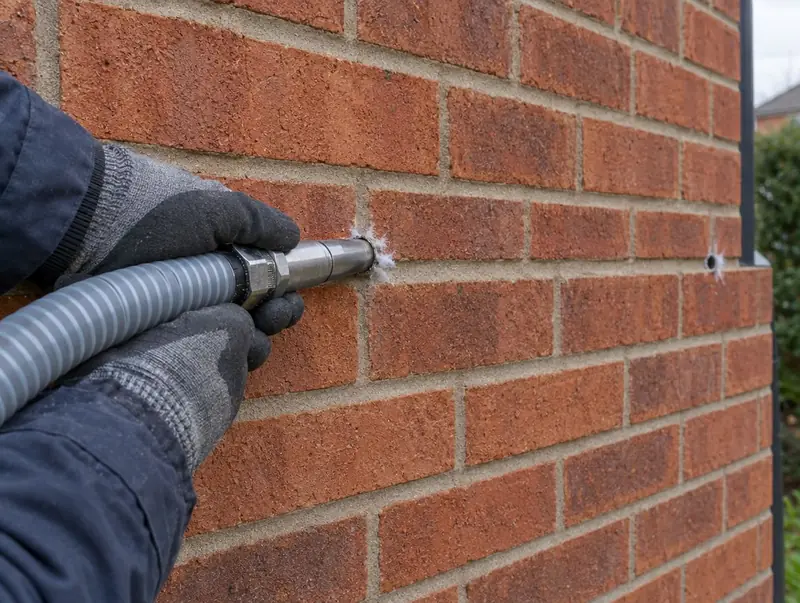
Holes of around 22mm are drilled in the mortar joints in a set pattern, roughly a metre apart. The insulation is blown in from the bottom up until each section is full, then every hole is filled with colour-matched mortar. Air bricks and flues are protected, and a cavity barrier is fitted where your wall joins a neighbour's.
For an average house with easy access to the walls, the filling itself takes a few hours. Scaffolding or a tower is only needed for three-storey walls or awkward access, and that is priced up front.
What is included
- Suitability survey with photos and a written result
- Borescope check where the cavity is in doubt
- Certified mineral wool or bonded bead system
- Drilling, filling and colour-matched making good
- Cavity barriers at party walls
- Building regulations route for your nation, confirmed in writing
- Guarantee and installer named on your quote
Cavity wall insulation prices in Nottinghamshire
| Cavity wall insulation guide prices | Guide price |
|---|---|
| Detached house | £2,295–£3,795 |
| Semi-detached house | £1,495–£2,495 |
| End-terrace house | £1,295–£2,195 |
| Detached bungalow | £1,295–£2,195 |
| Semi-detached bungalow | £895–£1,595 |
| Mid-terrace house | £795–£1,395 |
No VAT is charged on installing insulation in homes until 31 March 2027 (then 5%). Guide ranges only: the fixed price is confirmed in writing before any work starts, and anything that could not be seen at survey is agreed with you first.
From enquiry to finish in Nottinghamshire:
Get in touch
Online, by phone or WhatsApp, whichever suits you.
Survey visit
The surveyor checks each wall and looks into the cavity where needed.
Your result in writing
What we found, what it means, and a fixed price if work is needed.
Booked work
Carried out by the installer named on your quote, with their scheme registrations.