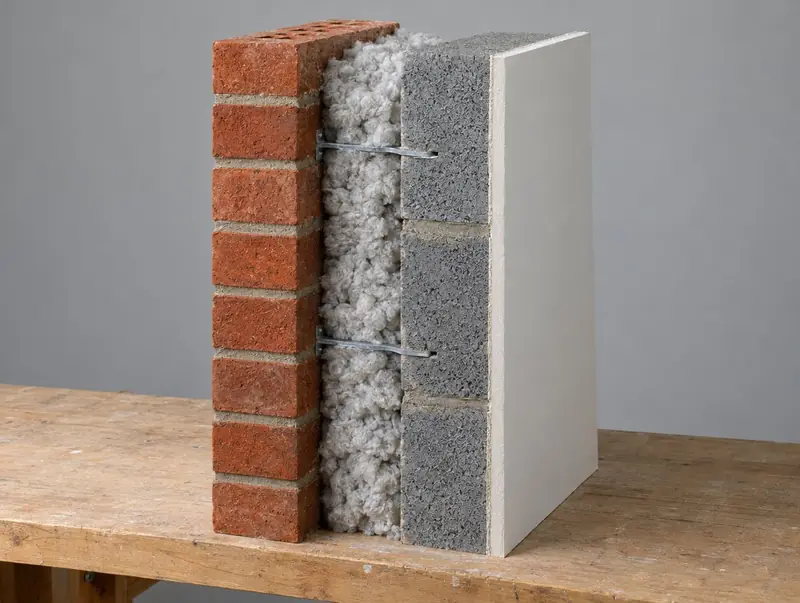
Why choose mineral wool?
Mineral wool fibres are treated to shed water, so moisture that gets into the outer leaf runs down the cavity rather than tracking across. It is classed as non-combustible, which matters for some flats and taller buildings, and it is usually the lower-cost certified option.
It is installed at a set density through a regular drill pattern. Too loose and it settles; too tight and it can bridge moisture. That is why the installer's density checks and hole pattern are recorded on the job sheet.
When is it not the right choice?
Very narrow or uneven cavities, walls with lots of mortar snots and debris, and some very exposed elevations can be better suited to bonded bead, which flows around obstructions and is certified for a wider range of exposure zones in some systems. The survey says which and why.
What is included
- Certified mineral fibre system
- Density and drill pattern recorded
- Making good to the mortar colour
- Cavity barriers where needed
- Regulations route and guarantee named on the quote
Blown mineral wool insulation prices
| Blown mineral wool insulation guide prices | Guide price |
|---|---|
| Detached house | £1,895–£3,395 |
| Semi-detached house | £1,295–£2,195 |
| End-terrace house | £1,095–£1,895 |
| Detached bungalow | £1,095–£1,895 |
| Semi-detached bungalow | £795–£1,395 |
| Mid-terrace house | £795–£1,295 |
No VAT is charged on installing insulation in homes until 31 March 2027 (then 5%). Guide ranges only: the fixed price is confirmed in writing before any work starts, and anything that could not be seen at survey is agreed with you first.
Rules and funding by nation
The building regulations route and the funding schemes differ between England, Wales, Scotland and Northern Ireland. The local pages for your area explain the rules where you are; in short:
- England: Filling a cavity is notifiable building work and needs a building notice or competent-person self-certification.
- Wales: Filling a cavity is notifiable work under the Building Regulations as they apply in Wales, usually self-certified through a competent person scheme.
- Scotland: No building warrant is needed for insulation within a wall, but the work must meet the building standards.
- Northern Ireland: Inserting cavity wall insulation needs a building control application to the council before work starts.
Sources: Energy Saving Trust: cavity wall insulation; Planning Portal: cavity wall insulation and building regulations; Welsh Government: building work competent person schemes; HMRC: VAT on energy-saving materials (Notice 708/6).