Cavity wall insulation across County Antrim
We cover 7 towns in County Antrim, including Belfast, Lisburn, Newtownabbey, Carrickfergus, Ballymena and more.
Before any material is chosen, exposure is checked. Parts of County Antrim face some of the heaviest wind-driven rain in the UK, especially exposed coastal and upland sites. Here the survey is stricter: some walls suit only certain certified systems, and some should not be filled at all.
County Antrim properties with rendered or painted walls get a closer look at the outer finish, because cracked render can let rain behind it. Most County Antrim houses built from the 1920s onwards have cavity walls, but the survey still checks each one: cavity width, debris, the condition of the brickwork and how exposed each wall is.
Building control in Northern Ireland
In Northern Ireland, inserting insulation into an existing cavity wall needs a building control application to your council before the work. We make sure the application route is agreed and confirmed in writing before any drilling starts.
Funding in Northern Ireland
- The Affordable Warmth Scheme, run with the NI Housing Executive, helps owner-occupiers and private tenants with a total gross household income under £23,000; cavity wall insulation is a priority measure where suitable.
- The NI Sustainable Energy Programme funds energy efficiency schemes through participating providers.
- ECO4 does not apply in Northern Ireland.
Sources: Building Control NI: frequently asked questions; Belfast City Council: what are the building regulations; NI Housing Executive: Affordable Warmth Scheme; Utility Regulator: NI Sustainable Energy Programme.
Is my wall suitable for cavity wall insulation?
Most homes built from the 1920s onwards have cavity walls, but having a cavity is not the same as being suitable. The Energy Saving Trust's rule of thumb is a cavity of at least 50mm, clear of rubble, behind masonry in good condition, on a wall that is not exposed to severe driving rain or flood risk.
That is what our survey checks: wall construction and thickness, cavity width and cleanliness (with a borescope where needed), the state of bricks, pointing, gutters and downpipes, any existing damp, and the exposure of each elevation. If a wall should not be filled, you will be told so in writing, with the reason.
What is included
- Suitability survey with photos and a written result
- Borescope check where the cavity is in doubt
- Certified mineral wool or bonded bead system
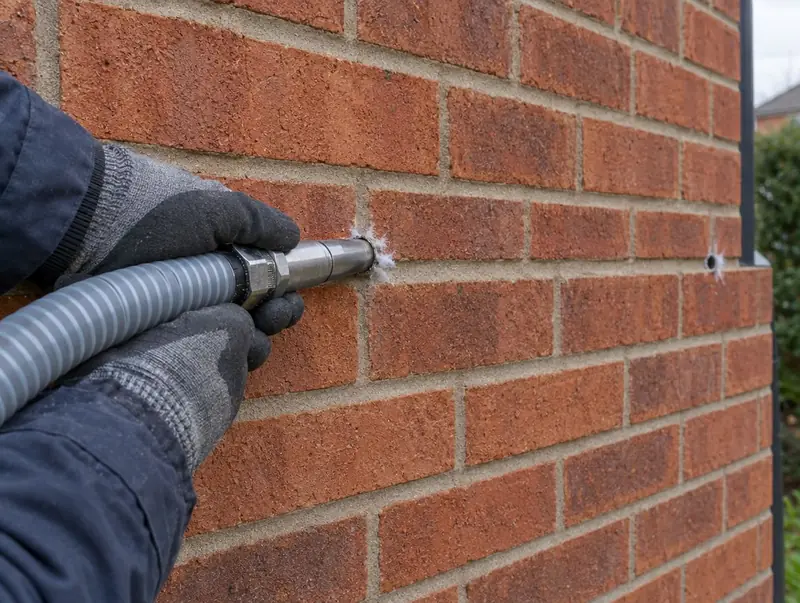
- Drilling, filling and colour-matched making good
- Cavity barriers at party walls
- Building regulations route for your nation, confirmed in writing
- Guarantee and installer named on your quote
Cavity wall insulation prices in County Antrim
| Cavity wall insulation guide prices | Guide price |
|---|---|
| Detached house | £2,295–£3,795 |
| Semi-detached house | £1,495–£2,495 |
| End-terrace house | £1,295–£2,195 |
| Detached bungalow | £1,295–£2,195 |
| Semi-detached bungalow | £895–£1,595 |
| Mid-terrace house | £795–£1,395 |
No VAT is charged on installing insulation in homes until 31 March 2027 (then 5%). Guide ranges only: the fixed price is confirmed in writing before any work starts, and anything that could not be seen at survey is agreed with you first.
What happens next for a County Antrim property:
Send your details
A minute online, or call the free number.
We check the walls
Construction, cavity width, debris, damp and wind-driven rain exposure.
You decide
Plain-English result and a fixed price, with no pressure to book.
Job done properly
Holes made good, paperwork handed over, guarantee details confirmed.