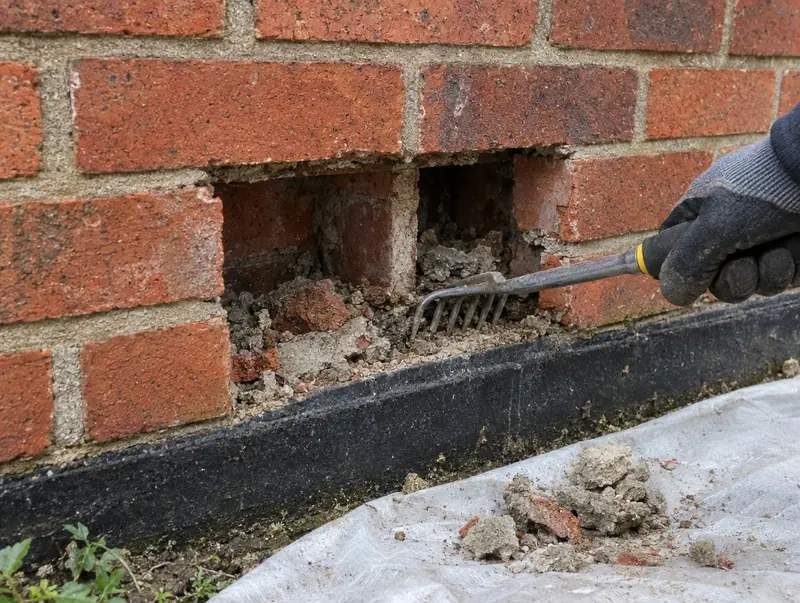
Why debris matters
A clean cavity lets water that gets through the outer leaf drain away. Debris piled at the base or caught on ties makes a bridge for that water. It is a common cause of damp low on walls and around ties, with or without insulation.
What is included
- Borescope check to locate debris
- Brick removal at low level
- Raking and vacuum clearance
- Rebuild in matching mortar
Cavity cleaning and debris removal prices
| Cavity cleaning and debris removal guide prices | Guide price |
|---|---|
| Cavity debris clearance, per elevation | £395–£795 |
| Whole-house debris clearance | £995–£1,995 |
This work is not insulation, so it is normally standard-rated for VAT. Guide prices include VAT where it applies. Guide ranges only: the fixed price is confirmed in writing before any work starts, and anything that could not be seen at survey is agreed with you first.
Rules and funding by nation
The building regulations route and the funding schemes differ between England, Wales, Scotland and Northern Ireland. The local pages for your area explain the rules where you are; in short:
- England: Filling a cavity is notifiable building work and needs a building notice or competent-person self-certification.
- Wales: Filling a cavity is notifiable work under the Building Regulations as they apply in Wales, usually self-certified through a competent person scheme.
- Scotland: No building warrant is needed for insulation within a wall, but the work must meet the building standards.
- Northern Ireland: Inserting cavity wall insulation needs a building control application to the council before work starts.
Sources: Energy Saving Trust: cavity wall insulation; Planning Portal: cavity wall insulation and building regulations; Welsh Government: building work competent person schemes; Welsh Government: issues arising from cavity wall insulation installations; CIGA: the CIGA guarantee; HMRC: VAT on energy-saving materials (Notice 708/6).