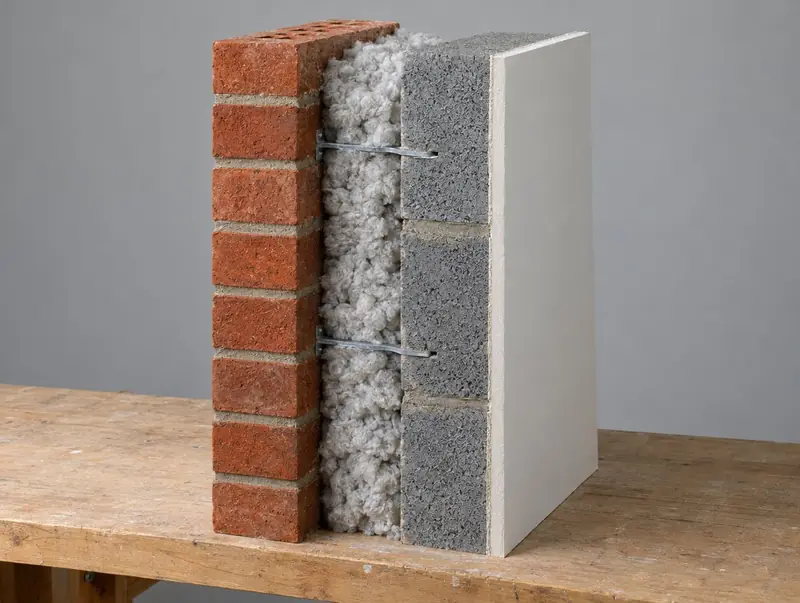
Blown mineral wool insulation across Devon
We cover 10 towns in Devon, including Plymouth, Exeter, Paignton, Torquay, Newton Abbot and more.
Before any material is chosen, exposure is checked. Parts of Devon face some of the heaviest wind-driven rain in the UK, especially exposed coastal and upland sites. Here the survey is stricter: some walls suit only certain certified systems, and some should not be filled at all.
Devon properties with rendered or painted walls get a closer look at the outer finish, because cracked render can let rain behind it. For semi-detached and terraced homes in Devon, cavity barriers are fitted where your wall meets your neighbour's so the fill stays on your side.
Building Regulations in England
Filling an existing cavity wall is notifiable building work in England. Either a building notice goes to building control before the work, or the installer self-certifies it through a government-approved competent person scheme such as CIGA's CWISC scheme. The insulation used must also be suitable for the wall it goes into, which is why the survey checks construction, condition and exposure first.
Funding in England
- ECO4, the energy-supplier scheme, has been extended to 31 December 2026 and government has said there will be no successor supplier obligation.
- The Great British Insulation Scheme closed as planned on 31 March 2026.
- Warm Homes: Local Grant supports low-income households in England through councils, and the January 2026 Warm Homes Plan sets out fully funded upgrades for low-income homes, with more detail still being published.
Sources: Planning Portal: cavity wall insulation and building regulations; CIGA: CWISC competent person scheme; GOV.UK: extending the ECO4 end date, government response; GOV.UK: Warm Homes Plan.
Why choose mineral wool?
Mineral wool fibres are treated to shed water, so moisture that gets into the outer leaf runs down the cavity rather than tracking across. It is classed as non-combustible, which matters for some flats and taller buildings, and it is usually the lower-cost certified option.
It is installed at a set density through a regular drill pattern. Too loose and it settles; too tight and it can bridge moisture. That is why the installer's density checks and hole pattern are recorded on the job sheet.
What is included
- Certified mineral fibre system
- Density and drill pattern recorded
- Making good to the mortar colour
- Cavity barriers where needed
- Regulations route and guarantee named on the quote
Blown mineral wool insulation prices in Devon
| Blown mineral wool insulation guide prices | Guide price |
|---|---|
| Detached house | £1,895–£3,395 |
| Semi-detached house | £1,295–£2,195 |
| End-terrace house | £1,095–£1,895 |
| Detached bungalow | £1,095–£1,895 |
| Semi-detached bungalow | £795–£1,395 |
| Mid-terrace house | £795–£1,295 |
No VAT is charged on installing insulation in homes until 31 March 2027 (then 5%). Guide ranges only: the fixed price is confirmed in writing before any work starts, and anything that could not be seen at survey is agreed with you first.
What happens next for a Devon property:
Get in touch
Online, by phone or WhatsApp, whichever suits you.
Survey visit
The surveyor checks each wall and looks into the cavity where needed.
Your result in writing
What we found, what it means, and a fixed price if work is needed.
Booked work
Carried out by the installer named on your quote, with their scheme registrations.